Κολέγιο CITY College
|
News & Events
Webinar and Recording for all students: Strengthening Resilience in times of crises: how to utilize social and psychological resources
Webinar and Recording "Strengthening Resilience in times of crises: how to utilize social and psychological resources" by Dr Suzie Savvidou Head, Department of Psychology Dr Vassilis Chatzimpyros Academic Director of Undergraduate Studies, Department of Psychology Watch the Webinar (Αccessible only to staff and students) Monday, May 4, 19:00-20:00 Overview: The COVID-19 pandemic has caused a number of risk factors leading to psychological issues such as stress disorders and depression. These issues are further affected by separation from family and friends and a disruption in our sense of belonging. This seminar will focus on the importance of the sense of belonging to our mental and physical health with regard to the pandemic and other social and psychological factors that make some people more prone to anxiety and depression than some others. It will also provide some ideas for self-reflection and for activating mechanisms to manage the dysfunctional emotions as they are triggered by the lockdown and emotional/social isolation.
28/04/2020

Free Webinar Series and Recordings: Digital marketing strategy to thrive in the pandemic and beyond
Free Webinar Series Digital marketing strategy to thrive in the pandemic and beyond To join the upcoming events and/or see the recordings of the events that took place, please visit the Webinar boxes below Join us for three short webinars where international expert panellists will share their digital marketing lessons learned at the time of the COVID 19 pandemic. ➤ Digital marketers around the globe are now facing unprecedented challenges. It is now up to them to manage internal communications with workforces that find themselves confined to their homes, as well as external communications with customers who have gone through a major re-prioritisation of their needs. Why join these online webinars? Hear reflection on lessons learned by others in digital marketing at the time of crisis Get inspiration from other marketers by observing and interacting with international experts See a wide range of organisations reflect on the use of digital marketing strategy and communications during the COVID 19 global pandemic. Who should attend? Marketers Practitioners Marketing students and enthusiasts Entrepreneurs Academics ➤ The webinars are part of the launch of the 2nd edition of Digital and Social Media Marketing: A results driven approach book. In the spirit of the book, to offer actionable advice as well as theoretical explanations, the sessions are structured around three elements of Digital Marketing strategy – Content, Channels and Data. These elements are central to developing of a customer centric digital marketing strategy as advocated in the book. ➤ Our own Dr. Ana Cruz, lecturer and researcher at CITY College, International Faculty of the University of Sheffield along with co-editors Dr. Aleksej Heinze KEDGE Business School, France, Dr. Gordon Fletcher and Dr. Tahir Rashid from Salford University edited the book. The first edition of the book was part of the JEMSS project funded by the LifeLong Learning Programme of the European Commission and CITY College participated as a partner. The second edition of Digital and Social Media Marketing book is an up-to-date, industry-led results-driven guide to digital marketing. It provides insight into, and techniques to enable, the creation, development and maintenance of a successful digital presence. Dr. Ana Cruz is teaching at our Master's programme in Digital Marketing and Social Media. How to book your place at the webinar? Book your place early, the webinars are free but places are limited. Attendees will have the chance to enter into a quiz competition to win one of three free electronic copies of the book. Please register to each one of the sessions individually. Time of webinar: All webinars take place at 14:00 hs (Greek Time). To see the exact time at your time zone, click the "Book your place" link below. WEBINAR 1 22nd of April. Digital content lessons to thrive in the pandemic and beyond webinar. The session focuses on lessons and cases to illustrate the development of content that connects during the pandemic and beyond by being empathetic and relevant to customers’ pain and trust points. Panelists: Olga Andrienko – SEM Rush. Head of Global marketing, USA Dr Natalia Wiechowski – CEO & Founder at Think Natalia, UAE Tina Judic – CEO at Found, UK Dr Alex Fenton – Lecturer in Digital Business at Salford Business School, University of Salford, UK Session’s chair and book’s editor: Dr. Ana Cruz. Lecturer and Brand Strategy Consultant. CITY College, International of the University of Sheffield, Greece Watch the webinar: WEBINAR 2 6th of May. Book your place Engaging digital channels: effective toolkit in times of crisis webinar Panelists: Hadeel Hmaidi – Social Content at Expo 2020 Dubai, UAE Serena Pasqualetto – Digital Marketing Manager at Pixartprinting, Italy Carla Dawson – B2B Growth Marketing Strategist / Hacker at Onmarc & xDawson, USA Dr Anna Tarabasz – Deputy Director MGB Internship / Assistant Professor Marketing at SP Jain School of Global Management, UAE Session’s chair and book’s editor: Dr. Tahir Rashid. DBA Director/ Senior Lecturer in Digital Marketing & Strategy. Salford Business School, UK. WEBINAR 3 20th of May. Book your place Effective use of data insights to deliver commercial results webinar Panelists: Tim Stewart – Consultant at trsdigital Ltd, UK Edouard Belouet – Managing Director – Accenture, France Ryan Deane – Media & Marketing Manager at Salford City Football Club, UK Christopher Hackett – Head of Technology at 7th Minute. UK Session’s chair and book’s editor: Dr Aleksej Heinze. KEDGE Business School, France Would you like to buy the book? You can use the following link for 20% discount for orders placed via the publisher website Would you like to request an inspection copy of the second edition of the Digital and Social Media Marketing book? Please contact the publisher- Routledge. Like to share? The event is open to all. Feel free to share the information to people and businesses that can benefit. We will use the #Passion4Digital hashtag on social media before, during and after the event!
28/04/2020

Career Acceleration Seminar Series
April - May 2020
27/04/2020

Social Media Freelancing Seminar
30 April 2020
27/04/2020
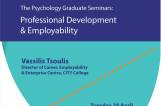
The Psychology Graduate Seminars: Professional Development & Employability
28 April 2020
27/04/2020

Professional Development Seminar Online: How to create a professional profile on LinkedIn & how to develop a Video-CV
5 May 2020
23/04/2020
Professional Development Seminar Online: Postgraduate Studies: Making the right choice
28 April 2020
23/04/2020
Professional Development Seminar Online Series by the Computer Science Department
April - May 2020
23/04/2020

Online Learning: Tips and Guidance for Good Practices
This document is a short guide for students. It is provided as a response to questions, remarks and comments we received during the first two weeks of online classes, from students and staff. There has been a positive attitude towards online delivery, from both staff and students, which will further facilitate maintenance of quality in learning and teaching. Following government social distancing measures due to the coronavirus pandemic, most leading Universities around the world switched to online delivery to address the temporary suspension of face to face classes. Universities chose between synchronous or asynchronous online models (or a combination) and made provisions for alternative assessment types to fit the current reality. We have to recognise that online learning is different from face to face learning, neither inferior nor superior. The below tips aim to address the key challenges that arise due to the sudden switch from face-to-face to online learning under a “lock-down” condition. Remote study is changing our university life so we hope the following tips will help you to maximise your online learning experience and to ease some of the current anxiety that is triggered by the global crisis. Prioritise your well-being Worry and stress are normal during this global challenge. Different people act differently, but your well being needs to be your priority. If you remain mentally and emotionally healthy, you will be able to protect yourself and keep your daily functionality intact. We are here to support you through the counseling center or e-help. Stay well informed about the crisis using only reliable sources. If you feel that you are running out of mental or emotional strength, please refer to your tutor and your Department. Focus on your minor and greater goals No matter what the situation is, you should stay focused as much as you can on your major educational goal “to learn, enhance your skills and become better”. This will entail subgoals such as “to complete the semester successfully”. Given all other personal and family circumstances, it may be challenging but you must not relax your goals and expectations. Sooner or later our lives will gradually return to normal. So, stay focused and achieve what you have planned for this academic year, that is, to proceed to next year or graduate. Keep yourself technically skilled This is the time you accept that technology is the only means to get you out of stagnation. You belong to a generation that compromised face to face social interaction with online social networking. It is time to accept that at these challenging times, technology will not only be there for your leisure and fun but for your education too. Get prepared. Be equipped with a camera and a mic. If you do not have or plan to buy one, your mobile and your handsfree perfectly do the job. Isolating yourself during the educational process will negatively affect your learning. Get used to the tools. Keep a positive attitude for technology, it is here to help. A decade ago technology would not be able to deliver. Be tolerant with glitches because little issues will always exist and no one is to blame. Problems are normally solved within seconds or minutes. Preparing for on-line classes: Setup a study environment Setting up your class attendance and study space is of absolute importance. If possible, choose a quiet room where disruption can be minimised. Keep away from physical distractions (e.g. other people moving around and talking, music background, TV on etc) but also isolate online distractions (mobile, web browser, videos, social media etc). Needless to say that good lighting contributes to your eye safety and health. Sitting at a desk is the most appropriate posture to attend classes or study which allows you to mentally focus on the on-line delivery. Do some pre-reading When you prepare for a class, this has an add-on effect to your learning. There is already uploaded material from previous classes you can revise. In some cases, the material for the next lecture is available in advance, You could even make a list of questions that you want to ask or even look at the syllabus to see what is coming next. In all cases, your chances to maximise learning are increased. During on-line classes: Follow your class schedule and make a new study routine Due to the abrupt way of stopping face to face classes, your study routine as it was before March was interrupted. We have decided to offer you the same schedule so that your daily routine interruption would be as minimum as possible. We encourage you to follow your classes and develop a revised study routine. Do not assume that class attendance will be easy. We understand that it is different to attend an online class in the sense that you are not physically “stuck” in a chair of a classroom; you might have other obstructions around you. But we suggest to focus in the same way as if you were in a physical classroom. Participate in classes actively As in face to face classes, some of you may choose to stay silent and listen. This is understandable although it does not facilitate your active learning. Online teaching gives you more opportunities to make one step forward and engage with the rest of the class. The chat box is an additional feature which most of you are acquainted with (due to social networks) and more open to use. The optimum, however, would be to use video and voice. Ease your fears, you are not going to be assessed neither on what you say nor on how you look or sound like. To the contrary, all lecturers will greatly appreciate seeing you on the screen and discussing with you. If you think it is a lonely task to attend a class, you can imagine how lonely it feels to teach a list of names on the screen with no interaction. On our side, we have been making tremendous efforts to engage you and we would be grateful if you respond, ask questions, make comments and challenge us. Again, be positive and tolerant with technology and small issues that might appear. They should not affect the whole spirit and learning process. And don’t forget that participation will help you to develop a skill, absolutely crucial for your future career. After your on-line classes: Organise your time for self-study We are living through challenging days during which time feels unstructured. Don’t you ever get the feeling that being at home you have all the time in the world but again when the evening comes you wonder where all this time went? You need to employ and enhance your time-management skills. We suggest you commit to a plan and pay extra attention to monitor your progress. This is one of the most challenging tasks in online learning. As you do with your assignments (coursework map), make a plan for your daily study tasks (study map). Organise your time wisely so that the workload is evenly distributed. Make sure that you take regular breaks and some off-screen time. Become an independent learner One of the most important attributes a University graduate should possess is to be an independent learner. An independent learner must find the appropriate time in the schedule to revise material, understand what he/she knows, realise what she/he does not know, search for additional clarifications and resources, watch the recorded lectures, practice on exercises and frequently do self-assessment reflection. It is normal to identify gaps to knowledge and skills but it is of extreme importance to be aware of what you can do about those gaps. Keep asking yourself: What? Who? When? Where? How? What-if? The answers are somewhere around you and you can always get help and advice from you teachers. Keep yourself connected with fellow students As you belong to the generation of social media, you have your own way to contact friends and family. We suggest you do the same with your fellow students. You are not on your own in this. Other students may be facing the same problems and you can share your concerns with them along with good practices. For example, the things you did and helped you out. It is a good opportunity to master the collaborative tools for group assignments. Organise and join study teams. Get involved with clubs and other activities. Many are offered online. Keep yourself connected with your lecturers and your tutors: open-port Your teachers are working as usual. Our open-door policy still applies in a different form though. We call it open-port policy, and includes all synchronous (skype etc) and asynchronous (email etc) communication you can have with your lecturers and tutors. As mentioned already, you are not alone in this. Contact your lecturers and your personal tutors. Get library support Library services are offered to students online. You have access to the Online library collections and resources including the electronic collections of databases, journals, ebooks and dissertations, the University of Sheffield library resources and all Open Access Resources. In addition, if you wish to borrow a book or other material, you may contact the Library staff to arrange it. The Library staff is available to help you and answer student queries via phone, email and our newly introduced library chat tool to enable faster and direct communication with the library. Finally, online learning yields positive learning outcomes: How will it be when this is over? What we can assure you is that on-line learning yields positive learning outcomes for each one of you: Development of new skills: “self-regulation” and motivation. This relates to your ability to plan, monitor and evaluate your behaviour and learning strategies. You also adapt to a new way of learning, learn how to manage time and communication on-line. Online delivery normally requires students to prepare and reflect on the subject matter before each class takes time-real time. This results in increased reflection and active learning experience. Online session recordings are available for future reference. This is an incredible added value as you can review at your own pace any session and allow more time to engage with the content. Collaborative learning: There are multiple options and tools available that you can master and use at a later time for collaboration and sharing. Good preparation for a changing workforce. Getting comfortable with technology is an excellent side benefit of the current situation. It is very likely that your future employers will require you to take classes on line as part of your life long training requirements. More and more often you will be asked to use online collaborative tools. Also, as companies cut down on expenses for corporate travel more and more meetings are held via video conferencing. This crisis has planted seeds for innovation and transformation in many aspects of our lives including teaching and learning. Your positivity, active engagement and commitment to keep doing what you are expected to do, will significantly contribute to maintaining the quality of your learning.
13/04/2020

Counselling Services via Skype for all
Given the wider situation that we are going through due to the Coronavirus pandemic, remember that we are here to help you. If you need psychological support and you want to make an appointment, send us an email. All requests are handled confidentially. Counselling sessions are assigned exactly as on a face to face basis, providing you have access to Skype and a space at your home that can be used for this purpose. Aiming at putting science at the service of the community, the Psychology Department of CITY College runs the Community Counselling Centre with the mission to provide psychological services to our community. To know more or make an appointment, send us an email at counselling@york.citycollege.eu
10/04/2020

CLASSES ONLINE IN REAL-TIME
The Coronavirus situation has created an extraordinary and unprecedented situation all over the world. Our desire is to protect our students, staff and the community and at the same time to give the opportunity to our students to continue their education and to complete their academic obligations on time. CITY College immediately moved all teaching online from 18 March 2020, taking responsibility to offer all education provision in full to all students. The classes are online and in real-time (synchronous) and with the help of technology take place in a virtual classroom that accommodates all features of a normal classroom. According to the latest updates related to the Coronavirus pandemic all universities and colleges of higher education in Greece continue to be restricted to offer face-to-face classes and are not permitted to allow students to enter their premises until 31/5/2020, as a necessary measure to control the spread of coronavirus and protect the population. Consequently, please be informed that until the end of the spring semester, there will be no face-to-face classes. CITY College academic staff, student services, library, career and employability staff, and all administration continue being fully operational and remain at your disposal. ADVICE FOR CURRENT STUDENTS Frequently asked questions for current students (Learning and Teaching) Frequently asked questions for current students (General) Α short guide for students on Online Learning: Tips and Guidance for Good Practices ADVICE FOR PROSPECTIVE STUDENTS Frequently asked questions for prospective students FAQ for current students (Learning and Teaching) 1. What does classes online in real-time mean? Online classes commenced on Wednesday 18 March. This is a brief description of how an online class takes place: the lecturer is online and guides the class as they do in face-to-face lectures, everything happens in real-time (synchronous), so you are able to see the slides or the whiteboard or a video etc. as you do in face-to-face classes, you have the opportunity to ask questions as normal, you can interact with your fellow students through instant messaging provided by the platform. In other words, a virtual classroom accommodates all features of a normal classroom, only without physical presence. All you will require for each virtual classroom is the following: you will receive a web link; by clicking the link you will enter a virtual room, you can physically be at any place as long as you have an internet connection, you can connect through any device such as PC, laptop, mobile phone, tablet etc. your device may have a camera although this is not a requirement, you should have a microphone if you wish to interact with the lecturer and/or fellow students. All classes are normally recorded as a video (where appropriate) and uploaded as normal for future reference. Any additional material will also be available as normal in MOLE. Academic staff will be available at all time as normal for consultation, guidance, tutoring etc. through Skype. We strongly believe that given the circumstances, the agreed online model will give you an equivalent opportunity to complete your modules on time and also meet the quality standards that you have enjoyed so far during your studies. 2. What is the safety net policy for exams and assessment? Given the exceptional circumstances in which exams and assessments are taking place, CITY College in line with the University of Sheffield has taken the decision, along with all major UK Universities, to implement a "safety net" policy which will recognise the value of marks students have already achieved up to March 2020 for assessed work. This means that no student who passes the year will receive an average mark or overall degree class lower than their current overall mark or degree class. Any summative assessment completed for the remainder of this academic year can only have a positive impact on a student's overall mark or degree class. Working through the processes required to put this safety net in place across the wide range of our degree programmes is going to be a complex task. Please bear with us as we work through the specific details and you will be informed accordingly. 3. What will happen to final invigilated exams? In terms of assessment methods, all formal invigilated exams will be replaced by online and other forms of assessment and you will not be required to be on campus. You will be informed about the alternative forms of assessment that will replace the formal invigilated exams for each unit (e.g. an extra assignment, an online quiz, an open book/open access exam or any combination of those) no later than April 30. All such alternative types of assessment will normally be held remotely during the examination period in June. 4. When will face-to-face classes be available again? The College will revert to face-to-face teaching as soon as it is allowed to do so by the Ministry of Health/Education Unfortunately, we cannot predict when face-to face provision will be allowed in Greece and other countries. We are closely monitoring the situation and we will keep you updated. 5. What will happen if classes at the campus begin and I am not available to attend? The College will revert to face-to-face teaching as soon as it is allowed to do so by the Ministry of Health/Education. However even if we revert to face-to-face delivery, we will simultaneously continue to offer our classes and services online in order to support all of those who are unable to physically attend, such as our international students that might be facing different circumstances. 6. How can I contact my lecturers and my course administrator? The academic staff and the course administrators of your Department are available and you may contact them by email. Academic Staff / Course Administrators Business Administration and Economics Department Psychology Department Computer Science Department English Studies Department 7. When will the semester end? The semester will end as initially planned. Due to the immediate action taken by the College, there will be no delays and the academic year will finish as planned. See the revised academic calendar in Thessaloniki here. FAQ for current students (General)
10/04/2020

SERVICES ONLINE
A high-quality student experience online in real-time! As physical presence and contact in campus is not possible for the time being, we want to continue to offer our services fully to our students online. We also want to encourage and allow our students to continue to have joint extra-curriculum activities and to enjoy a shared student experience. Like the very best universities around the world, we have taken the decision to deliver our teaching on-line in real-time as a response to the Coronavirus pandemic and the necessity for our students to continue without further delays their studies. We have decided to go beyond the classroom. We are going online all the way and we are trying to optimize this experience every day. Join us online! ADVICE FOR CURRENT STUDENTS Frequently asked questions for current students (Learning and Teaching) Frequently asked questions for current students (General) Α short guide for students on Online Learning: Tips and Guidance for Good Practices ADVICE FOR PROSPECTIVE STUDENTS Frequently asked questions for prospective students FAQ for current students (General) 1. Which premises can I have access? Both buildings in Thessaloniki (L. Sofou Building and Pr. Koromila Building) are not accessible to students. This includes the Information Learning Commons, the Library and the Labs. However, academic and administrative staff are working and you may contact them directly. 2. Can I visit the Library? Can I borrow a book? The Library as a physical space is not accessible to students. However, all online and interlibrary loan services are available and the Library staff are available to help you and answer student queries (via phone or email). If you wish to borrow a book or other material, please contact the Library staff to arrange it (library@york.citycollege.eu). For further information, please visit the ONLINE Library Services and the Library webpages. 3. What services can I have access? The administrative staff are working and you may contact them directly. All professional services staff, including Student Services, Careers Employability and Enterprise Centre, Library, IT and Support, Academic Registry (for transcripts, diplomas etc) are available to contact via email: Student Services & Alumni: tkyriakou@york.citycollege.eu Careers Employability and Enterprise Centre: dkiakidis@york.citycollege.eu Library Services: library@york.citycollege.eu Academic Registry: gassi@york.citycollege.eu (for BAED, PSY), lithoxoidou@york.citycollege.eu (for MBA, CSD, ESD) Admissions Services: ergen@york.citycollege.eu Finance services: asimitsidou@york.citycollege.eu See all professional services contact details here. 4. I need advice on my visa and residence permit Ιf you need advice on a visa or residency matter, it is important that you contact Ms Theofano Kyriakou from the Student Services & Alumni Department directly. She will be able to advise you depending on your particular situation. If you need more advice on the matter, please contact Student Services & Alumni: tkyriakou@york.citycollege.eu 5. I rent an apartment in Thessaloniki and I am now in my home country. What shall I do? At the moment there are no new measures in Greece regarding the situation created by the Coronavirus pandemic relating to flats rented by students. As accommodation contracts are between you and your landlord, we suggest that any matters regarding the payment of your rent should be discussed with your landlord in order to agree a plan of action with them. Please note that according to the law you can not terminate your accommodation contract unilaterally. If you need more advice and guidance on the matter, please contact Student Services & Alumni: tkyriakou@york.citycollege.eu 6. I need a transcript, a certificate, a copy of my diploma, etc. What should I do? If you need any official documentation such as a transcript, you should contact the Academic Registrar responsible for your academic department. Below you may find the contact details of the relevant Academic Registry Office staff members: Academic Registry: gassi@york.citycollege.eu (for BAED, PSD), lithoxoidou@york.citycollege.eu (for MBA, CSD, ESD) 7. I need advice on my CV and how to find a job If you need advice on your career prospects and professional development, you email Mr Dimitris Kiakidis directly: Careers Employability and Enterprise Centre: dkiakidis@york.citycollege.eu Also, please visit the Careers Employability and Enterprise Centre webpages to see all the services that are offered online for all students, including online Career Counselling sessions, Internships and Mentoring opportunities and links to the Career Repository. 8. How can I make an appointment with the Counselling Services online? Our counselling services continue to be offered to our students and staff for free using Skype. If you are aware of anyone who needs psychological support in order to strengthen their resilience or if they are going through any other challenge and feel they need to ask for help, please refer them to the Psychology Department. They can contact the Department by calling at 00 30 2310 22 4421 and leaving their phone number or by emailing counselling@york.citycollege.eu Note that all requests are handled confidentially and sessions are provided under close supervision. Counselling sessions will be assigned exactly as on a face to face basis, providing that students have access to Skype and there is a space in their home that they can use for this purpose. 9. How can I contact CITY Students Union? If you want to contact your Union officers, you may do so through the CSU’s social media or directly by email: President: csupresident@york.citycollege.eu Vice President: csuvicepresident@york.citycollege.eu Public Relations and Communications Officer: csupublicity@york.citycollege.eu Welfare and Education Officer: csuwelfare@york.citycollege.eu Sports and Recreational Activities Officer: csusports@york.citycollege.eu CSU on Facebook CSU on Instagram 10. How can I find out which student clubs are active online? You can follow us on our central social media and visit our website where we publish all relevant information for current activities. You may also contact the student clubs directly. See more information about the student clubs and their contact details. To follow us on our central Facebook and Instagram, see below: CITY College on Facebook CITY College on Instagram CITY College on LinkedIn See all of our social media here. 11. Are events still taking place? In line with the government advice, all planned CITY College and Student Union events that require physical presence have been cancelled until further notice. All other events have moved online. 12. I need to contact a staff member at CITY College The academic and administrative staff of CITY College are available and you may contact them by email. Academic Staff Business Administration and Economics Department Psychology Department Computer Science Department English Studies Department Professional Services Staff Student Services & Alumni: tkyriakou@york.citycollege.eu Careers Employability and Enterprise Centre: dkiakidis@york.citycollege.eu Library Services: library@york.citycollege.eu Academic Registry: gassi@york.citycollege.eu (for BAED, PSY), lithoxoidou@york.citycollege.eu (for MBA, CSD, ESD) Admissions Services: ergen@york.citycollege.eu Finance services: asimitsidou@york.citycollege.eu See all professional services contact details here. 13. I need to pay my tuition fees. Does the temporary move to online teaching affect my tuition fees? In light of the decision by the Greek Ministry of Education and measures taken by other countries to suspend classes and cancel travel due to the Coronavirus pandemic, in order to protect the health and well being of our students, City College has taken all reasonable steps to ensure that students have the opportunity to complete their studies on time and without delay. City College immediately moved all teaching online from 18 March 2020, taking responsibility to offer all education provision in full to all students. The classes are online and in real-time (synchronous) and with the help of technology take place in a virtual classroom that accommodates all features of a normal classroom. All teaching hours are taught, all educational processes are in place, all academic staff are contactable and the library and all student and professional services are available online. We are confident that the steps we are taking are appropriate in the circumstances (which are beyond our reasonable control), and that they will enable your continued progression. Therefore, in these circumstances and in accordance with the latest decision by the Greek Ministry of Education (April 8, 2020), tuition fees are not affected and should be paid in full. If you need any clarifications and information regarding the payment of your tuition fees you may contact the Finance Office directly. Finance services: asimitsidou@york.citycollege.eu FAQ for current students (Learning and Teaching)
10/04/2020
  55 from 163 55 from 163   |