Κολέγιο CITY College
|
News
Paper co-authored by Dr. Lagkas among the most downloaded at IET Networks
The paper entitled “Hybrid 5G optical-wireless SDN-based networks, challenges and open issues” that was co-authored by Dr. Thomas Lagkas, Lecturer at the Computer Science Department of the International Faculty, CITY College, is among the most downloaded papers of the IET Networks Journal. The specific paper, which focuses on a set of critical challenges in advancing 5G networks through network function virtualization and software defined radio techniques, was published in August 2017 and in short time entered the journal’s list of most downloaded papers. The International Faculty warmly congratulates Dr Lagkas on this achievement.
02/03/2018
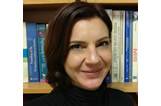
Interview with Dr Ioanna Stamatopoulou
Dr Ioanna Stamatopoulou Lecturer, Computer Science Department A lady teaching at the Computer Science Department. How does it feel to be part of a traditionally male-dominated field? It feels very natural, actually! It was always clear to me that this is my inclination and the fact that Computer Science, like all STEM (Science, Technology, Engineering, Mathematics) areas, is male-dominated was never an issue. The reasons why this happens is another story. We know the reasons and we know they are a residue from older times when the role of women in society was very different. The fact that STEM areas are still male-dominated says something bad about our secondary education systems. Our societies have changed but our educational systems have not. They fail to keep up. On the other hand, the Computer Science department of the IF, led by Ms Anna Sotiriadou, goes against the “rule”. You cannot say women are under-represented where I work... When did you realise that you fit in Computer Science? When I made the decision to study Computer Science I knew absolutely nothing about it. I had hardly switched a computer on and off! All I knew was that I was good at STEM subjects and that I wanted to study it; it was my personal challenge; a mature decision as much as it was a whim. I actually realised I fit in sometime during my Bachelor's studies. I guess I woke up one day and thought “I'm quite good at this and I want to know more”. Rumour has it that you are a ‘book-worm’. What kind of books do you like to read? I object to the characterization! I am not a simple book-worm. I am the proud Queen of book-worms! I have a book constantly on me and I read everywhere―while waiting for the bus, on the bus, in the doctor's waiting room... I try to read about 35 books a year, mainly classics, a lot of 19th century British literature, and contemporary crime mysteries and thrillers. I am lately also expanding into scientific fiction and (mainly Greek) poetry. Tell us a few words about the ‘Book Club’ you lead at the International Faculty. We, book lovers, are unfortunately a quite rare species (that's another fail of our educational system...). The International Faculty's Book Club aims to bring us “crazy people” together. Book readers, we are inherently curious people―we want to know what others are reading, why they like it (or not), and what other people believe is worth reading. The book club is just a bunch of friends discussing what we read individually, but also voting on common books to read so that we later exchange our views and opinions, while having a coffee or drink. Because, “no two persons ever read the same book”... Which was your funniest teaching moment? Which was your most awkward teaching moment? Unfortunately, I can't share either. The first would be “lost in translation” and the second is also the most embarrassing. Let's just say I really really really enjoy teaching and leave it at that. What is your ideal Sunday morning? It's summer. I wake up really early in a trailer that is parked right in front of the sea, make myself a coffee and enjoy the sunrise. From then on it's a cycle of swim, read, swim, read, grab a beer... If you didn’t live in Greece, where would you like to live? Why? Scotland, Canada, or Australia. I'd choose the first for its people and its natural beauty, the second because it appears to be the most decent country to live in, and the third because the other two are too cold for me! What inspires you? Inspiring people! A person who shows more kindness than that they receive, a teacher who is better than I am; a writer who expresses what we are thinking or feeling better than we can; an artist who constantly outperforms themselves; the curiosity, imagination, and creativity of a child. What makes life meaningful? The little moments: my kids when they laugh for absolutely no reason; having friends over for lunch; my students when they break a mental barrier; a beer (or five…) under the sun; a swim in the sea; listening to music while reading a book. Happiness is about increasing the amount of moments we enjoy at the cost of those we don't.
29/11/2017
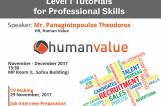
Tutorials for Professional Skills by Human Value
28/11/2017

Company Visit to Veltio and Apifon by Computer Science students
23/11/2017
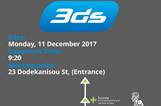
Company Visit to 3DS by Computer Science students
23/11/2017
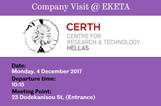
Company Visit to EKETA by Computer Science students
23/11/2017
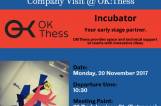
Company Visit to OK!Thess by Computer Science students
15/11/2017
A great start for the Professional Skills Seminar Series of the Computer Science Department
Mr Leonard Shtika The Computer Science launched this year’s Professional Skills Seminar Series with two insightful seminars. The series kicked off on 19 October 2017 with a seminar on ‘Website boost with SEO’ by Mr Leonard Shtika, Software Engineer at Tessera Multimedia and Google Analytics Certified Expert. Mr Shtika shared his expertise and explained how a search engine works today, elaborated on the high significance of search engine optimisation as an extremely important factor of the success of any website, and provided methods and tips how to increase the SERP ranking. The second seminar of the Professional Seminar Series was delivered by Mr Petros Amoiridis, Manager at GitHub. In his presentation entitled 'Contribute effectively to open source on GitHub using Git' he described the GitHub Flow as the easiest way to collaborate using the GitHub platform and provided useful information on working on topic branches and keeping the latest stable production code in the master branch. Moreover, the way to use pull requests and code reviews was detailed. Students found both seminars particularly useful and gained valuable insights. Mr Petros Amoiridis The Professional Skills Seminar Series run annually by our Computer Science Department is a very successful series of seminars that features seasoned professionals who deliver guest lectures on range of contemporary topics. The Series aims at furnishing our students with more practical and technical knowledge and better preparing them for real life challenges in their future working environments. View upcoming Professional Skills Seminars for academic year 2017-18.
14/11/2017
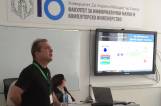
Professor Kefalas representing the International Faculty at the 8th Balkan Conference of Informatics
The presence of the International Faculty in the 8th Balkan Conference of Informatics was consolidated by two papers presented by our Vice Principal for Teaching and Learning, Prof. Petros Kefalas, in Skopje at the end of September. Prof. Kefalas’ contribution to this Conference also included his role as a Programme Committee Chairperson and Editor of the Conference Proceedings. During the Conference, Prof. Kefalas had the opportunity to present two distinct papers; the first one, entitled The Invalidity of Validating Emotional Multi-Agent Systems Simulations, was co-authored with Dr Ilias Sakellariou from the University of Macedonia. The paper discussed the issue of validating simulations that involve emotional agents. In the study of disaster management scenarios, such as emergency evacuations, simulations are developed to demonstrate the behaviour of people acting under emotional pressure. Prof. Kefalas and Dr Sakellariou argued for believability instead of validity of simulations of emotional multi-agent systems in such scenarios. The second paper, under the title Using Screencasts to Enhance Logic Programming Skills, was co-authored with Dr Ioanna Stamatopoulou, a staff member of the Computer Science Department of the International Faculty CITY College. This particular paper argued for the use of screencasting as a tool within a pedagogical context and highlighted its usefulness by exploring a number of techniques and methods in which it can be employed. In general, the Balkan Conference of Informatics (BCI) is a series of conferences initiated in 2003, targeted at bringing together experts and researchers from across the Balkans and beyond, working in the areas of Computer Science and Information Technology. The conference series is meant to ferment ideas, initiate discussion and disseminate the latest studies carried out in Informatics. Above all, the conference is meant to act as a platform of collaboration and intellectual confrontation for established scientists and young researchers of the Balkan region.
20/10/2017
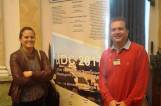
Staff Members of the Computer Science Dept. in the 11th International Symposium on Intelligent Distributed Computing in Belgrade
Staff members from the Computer Science Department of the International Faculty CITY College participated in the 11th International Symposium on Intelligent Distributed Computing (IDC) that brought together a great number of researchers. The event was hosted in Belgrade (October 11-13). More precisely, Prof. Kefalas, Vice-principal for Teaching and Learning, was invited to Chair the Plenary Session of a conference, which constitutes a forum for the dissemination of studies in the emergent field of Intelligent Distributed Computing and an intellectual space where collaboration between researchers from Intelligent Computing and Distributing Computing communities are forged. Meanwhile, Dr Ioanna Stamatopoulou, Dr Konstantinos Dimopoulos and Prof. Kefalas made a joint contribution through their paper “Teaching, Learning and Assessment of Agents and Robotics in a Computer Science Curriculum.” This paper is a demonstration of the authors’ experience in integrating agents and robotics in their Computer Science Curriculum. The authors further presented a series of modules that progressively address these themes and other AI-related topics in their Curriculum. Finally, Ms. Krenare Pireva, a current SEERC doctoral student supervised by Prof. Kefalas, presented the paper “A recommender system based on hierarchical clustering for Cloud e-Learning” – in co-authorship with Prof. Kefalas. Cloud e-Learning (CeL) constitutes a novel e-learning paradigm, aiming to use any learning object from the cloud and to generate a personalised learning path for individual learners. In this paper, Ms. Pireva and Prof. Kefalas presented a Recommender System for Cloud e-Leaning that uses hierarchical clustering to select the most appropriate learning resources. Our warmest congratulations to our colleagues on their inspiring work!
18/10/2017
Professional Skills Seminar Series by the Computer Science Department
18/10/2017
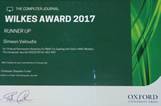
Dr Veloudis awarded the Runner-up Wilkes Award 2017
Congratulations are in order for Dr Simeon Veloudis on receiving the runner-up Wilkes Award for his paper entitled ‘A Novel Permission Hierarchy for RBAC for Dealing with SoD in MAC Models’ that was published in The Computer Journal of the Chartered Institute for IT (BCS). The Wilkes Award is given once a year to the authors of the best paper published in the volume of The Computer Journal from the previous year. Dr Simeon Veloudis holds a BSc and a PhD degree in Computer Science from the University of Reading. He has been employed for several years as a lecturer at various educational institutions. Currently he is a research associate at the South East European Research Centre (SEERC). His research interests lie in the realms of formal security modelling, in cloud computing, and in real-time safety critical systems. He has a number of publications in related conferences and journals. The International Faculty wishes to congratulate again Dr Veloudis on his achievement depicting the high-calibre research produced by our faculty’s academics. Runner-up winning paper: A Novel Permission Hierarchy for RBAC for Dealing with SoD in MAC Models Simeon Veloudis and Nimal Nissanke The Computer Journal (2016) 59 (4): 462-492. doi.org/10.1093/comjnl/bxv060
31/08/2017
  8 from 12 8 from 12   |