
Κολέγιο CITY College
|
News

Interview at FM 100 with Mr. Pavlidis about the 50+ Hellas programme in Touchscreen technology
Mr George Pavlidis, Lecturer at the Psychology Department of the International Faculty was invited at FM 100 to discuss the educational programme entitled ‘Access to the Digital World’ with a focus on Touchscreen technology, that is offered by 50+ Hellas to participants over 50 years old. During the interview Mr Pavlidis, who is also PhD candidate in Gerontology and is leading the programme, discussed the opportunities offered through this educational programme to people over 50 years old who want to get acquainted with new technologies with the use of tablet, since they have become a big part of our lives. Mr Pavlidis interview on FM100
29/03/2018

Dr Papamalis and Dr Chatzimpyros participate in the 1st National Interdisciplinary Conference on Prevention in Thessaloniki
Dr Fivos Papamalis, Lecturer at the Psychology Department of the International Faculty, Research Associate at SEERC and Director of SENSE, and Dr Vassilios Chatzimpyros, Lecturer and Research Director at the Psychology Department, participated in the 1st National Interdisciplinary Conference on Prevention that took place Thessaloniki, 9-11 March 2018. Dr Fivos Papamalis Dr Vassilios Chatzimpyros More particularly, the speakers delivered two insightful presentations at the event. The first presentation entitled “Evaluation as a tool for policy mapping, resource reallocation and intelligent – led prevention and treatment strategies” was led by both Dr Papamalis and Dr Chatzimpyros, while the second presentation, “INSPiRED - Implementation research framework for Strategic Prevention and Early Detection” was led by Dr Papamalis. Representing the International Faculty CITY College, both lectures shared their ideas and research findings together with other distinguished speakers.
22/03/2018
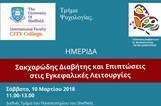
Event on Diabetes
The following event will take place in Greek. FREE ENTRANCE Online Participation Form Join and share!
06/03/2018

Successful seminar on Neuropsychology by Dr Anna Emmanouel in Skopje
On Saturday, 24 February 2018 a seminar on Neuropsychology organised by the Psychology Department of the International Faculty of the University of Sheffield, CITY College took place successfully, introducing students to the fundamentals of neuropsychology, a novel topic for them. The event was well-organised in cooperation with the psychology students’ association, PSIHESKO. The seminar was delivered by Dr. Anna Emmanouel, Clinical Neuropsychologist and Lecturer at the Psychology Department of the International Faculty of the University of Sheffield. During her insightful presentation Dr. Emmanouel shared her experience, while participants expressed great interest showing that neuropsychology is a promising and very interesting topic. The seminar comprised two parts. The first part was on cognitive neuroscience, its aims, advanced neuroimaging methods that are used to define brain pathology as well as differentiations in brain pathology between different types of dementias and how this is reflected on patients' neuropsychological profile in different stages of the disease. The second part was on clinical neuropsychology, that is application of this knowledge into clinical practice, emphasis was given on the methods that clinical neuropsychologists use to measure brain dysfunction in patients with acquired brain damage, the psychometric properties of these methods and the contribution of the neuropsychological assessment outcome to set treatment goals and apply interventions adjusted to patients' needs and difficulties. During the lectures, many videos were presented, introducing participants in the newness of neuroscience and cases of brain-injured patients with great research and clinical interest. The seminar was open to the public and was just one of the many events organised by the International Faculty of the University of Sheffield in Skopje, aiming at disseminating knowledge, often in cooperation with a large number of local institutions and organisations.
01/03/2018

Insightful presentations at the ‘Psychology for all’ series
Two insightful talks were presented in February by distinguished Psychologists who joined as guest lectures the ‘Psychology for all’ series that continues to be offered by our Psychology Department at our main campus on Thessaloniki. A talk on ‘Science or Psychotherapy’ took place 2 February with Mr. George Giaglis, MD, MSc, PhD, Specialist Neurologist, Psychologist and Gestalt Psychotherapist and Mr Rama Sadmon, Social and Clinical Psychologist, Psychotherapist & Gestalt Supervisor delivering a joint presentation and attempting to pinpoint the relation between the two as well as the difference. The International Faculty was also honoured to host for a second time Ms Katia Hatzilakou, M.Sc. Clinical & Social Psychology (A.U.Th.). Gestalt Psychotherapist, Trainer & Supervisor, member of EAGT (ex-Chair of NOGT and External Relation of EAGT) and the National Psychotherapy Company of Greece as well as ECP holder (European Certificate of Psychotherapy) and Founding member of the Hellenic Association for Gestalt Therapy (HAGT) who presented an interesting topic on self-esteem entitled “What holds me back is who I think I am not, rather than who I really am … the process to self-esteem.” Ms Hatzilakou explained that our beliefs of what people think they cannot do or things they think they are not worth are in fact the reasons they have low self-esteem and fail to see their worth and succeed. Both events were well-attended, giving the opportunity to participants to reflect on the topics presented and discuss with the speakers.
01/03/2018

Our Psychology Department mourns the loss of two great Psychologists
The Psychology Department of the International Faculty CITY College would like to share the sad news of two Psychology giants who passed away in the last days. Anne Treisman, a British Psychologist who made major contributions to the understanding of attention and perception and Erik Erikson who is best-known for his famous theory of psychosocial development and the concept of the identity crisis. More information: Read related article in NY Times Read related article in Verywell Mind
20/02/2018

New project on Women Pioneers of Neuroscience in Europe recommended by our Psychology Department
The Psychology Department of the International Faculty CITY College highly recommends the new European History project "Untold Stories: the Women Pioneers of Neuroscience in Europe" from the Federation of European Neuroscience Societies. The project presents the stories of seven women who worked during the first half of twentieth century and made relevant contributions to many fields of the modern neuroscience. Visit http://wineurope.eu
15/02/2018

Seminar on Neuropsychology by Dr Emmanouel in Skopje
24 February 2018 FREE ENTRANCE Online Participation Form View Dr Emmanouel short bio Information / Registrations: T: +389 2 3064 533 E: marija.nikovska@citycollege.sheffield.eu
05/02/2018

Second publication by Dr Papamalis from the Council of Europe on drug control policies
Dr Fivos Papamalis, Part-time Lecturer at our Psychology Department, research consultant to the Pompidou Group of the Council of Europe and member of the EU expert group on Possible adverse effects and associated cost of drug control policies, contributed on the development of the second publication of the group focusing on Costs and Unintended consequences of drug control policies. More specifically, Dr Papamalis initially on behalf of the Council examined the current state of the art of the effects and associated costs of drug control policies to individuals, this involved reviewed the evidence base and conducted a thorough literature review on the effects of drug control policies to the individuals and the society; conducted policy analysis and explored methodologies on estimating drug public expenditures and developed policy recommendations; drafted a narrative report and successfully coordinated discussions and negotiations among the expert group and policy makers. In the second research phase as a research consultant to the Norwegian Ministry of Health and Care Services and the Institute of Public Health, Dr Papamalis conducted research on the unintended consequences of EU drug control policies, including Health, Social and Economic functioning, Safety and Public order and Criminal justice, examined relevant databases such as the EUROSTAT, UN-CTS (Crime and Criminal Justice Statistics), SPACE, European Sourcebook on Crime and Criminal Justice Statistics OECD and provided an estimation methodology based on modelling and integrative data collection from the EU databases. The output of this study was the development of the Chapter 3 of this publication and in collaboration with the expert group the development of a comprehensive policy report that was reviewed by the permanent correspondents of the EU member states earlier this year. Summary of the Report Estimation or full costing of drug-related public investment including both direct expenditure and also indirect costs and impact on public resources should therefore be a key objective of any evaluation. Report by the expert group on possible adverse effects and associated costs of drug control policies. Evaluation is an integral part of a good governance approach to public policy. This principle applies equally to the component of drug policy designed to counter the availability of and access to illicit drugs. Estimation or full costing of drug-related public investment – including both direct expenditure and also indirect costs and impact on public resources – should therefore be a key objective of any evaluation. To evaluate and improve drug policy, it is imperative to know and take note of all possible effects of different interventions and actions. All policies, regardless of purpose or intention, come with a risk of unintended consequences. Public expenditure estimates can be used as a tool for assessing whether the expected or desired results of the policy in question are actually reflected in action, and they constitute a necessary tool for implementing thorough policy evaluations. Public expenditure studies should mirror all relevant activities and policy approaches and may be particularly appropriate in times of austerity. Accurate estimates of public spending will help policymakers plan relevant interventions and allocate necessary funds to authorities in charge of specific aspects of the policy’s implementation. A thorough assessment of drug policy expenditures will also contribute to improved transparency and accountability of public institutions. This publication brings together the findings of wider study conducted by the Pompidou Group in cooperation with the EMCDDA seeking to identify the unintended effects and associated costs of drug control policies. The aim of this publication is threefold. First, increase international awareness about the importance of estimating public expenditure on supply reduction initiatives. Second, stress the importance of harmonizing definitions and increasing availability, comparability and reliability of data as well as methods for sound estimates. Third, contribute to developing sound estimation practices to obtain accurate, complete and reliable drug policy evaluations.
10/01/2018

Dr Papamalis contributes research publication on drug control policies to the Joint Report of the EMCDDA
Dr Fivos Papamalis, Part-time Lecturer at our Psychology Department, recently co-authored a joint EU publication on Public Expenditure on Supply Reduction Policies that was published by the Joint Report of the EMCDDA – Pompidou Group of the Council of Europe. Mr Papamalis has served as a member of an expert group engaged by the Pompidou Group of the Council of Europe for the project ‘Possible adverse effects and associated cost of drug control policies’. In 2015, Mr Papamalis had an individual contract with the Council in order to examine the current state of the art of the effects and associated costs of drug control policies to individuals. Subsequently, was also hired as scientific consultant by the Norwegian Ministry of Health to undertake written tasks in support of the work of the Expert Group. Among other things he contributed to (i) developing the tables of the unintended consequences of drug control policies, including Health, Social and economic functioning, Safety and public order and Criminal justice and (ii) writing the main chapter on the Unintended Consequences of drug control policies including scientific literature, fully referenced. Due to his scientific background and technical skills, he also signed a contract with the Norwegian Institute of Public Health, Norway, in 2016, to further support the work of the Expert Group where he successfully developed a comprehensive narrative report of the associated harms of drug control policies and on the evidence based harm reduction interventions. During his tenure, Mr Papamalis also examined the available EU databases on the drug control public expenditures, in order the propose strategies for estimating different components of drug-related public expenditure across the EU and to facilitate the transition towards an evidence based resource relocation. This Joint EMCDDA-Pompidou Group Report is part of the work conducted by the Expert Group on “Possible adverse effects and associated cost of drug control policies”. The final report will come out in December, following permanent correspondents’ consultations.
10/01/2018

Guest Lecture on the Origins of Psychosis
Information T: +30 2310 224421 E: gvasileiadou@citycollege.sheffield.eu Abstract It has commonly been assumed that the psychotic disorders (conditions that involve hallucinations and delusions, and which usually lead to diagnoses such as ‘schizophrenia’ or ‘bipolar disorder’) are largely genetic in origin. This assumption is usually justified by referring to heritability estimates that exceed 80%. However, these estimates are not measures of causation and their misinterpretation is an example of one of the most common mistakes in statistics – assuming that correlation proves causality. In fact, major environmental influences are possible even if heritability approaches 100%. The only way of assessing these influences is to look for them. In recent years, considerable evidence had accumulated on a range of environmental risk factors for psychosis, including urban environments, poverty, migration and trauma. In each of these cases, the effects are particularly strong when these exposures occur in childhood. The guest lecture will focus particularly on the effects of childhood trauma which, in a meta-analysis, raises the risk of adult psychosis by a factor of 3. In three epidemiological datasets, specific patterns of association were found, with childhood sexual abuse being a particular risk factor for hallucinations and disruption of attachment bonds a particular risk factor for paranoid beliefs. These findings point to psychological mechanisms that explain these associations: dissociative states in the case of hallucinations and insecure attachment styles in the case of paranoia. Implications for the treatment and prevention of severe mental illness will be discussed.
10/01/2018

‘Psychology for all’ starts with two successful talks for academic year 2017-18
The ‘Psychology for All’ open lectures series kicked of for academic year 2017-18 with two particularly successful events that took place in November and December 2017. The first event on ‘Eating Habits and Disorders’ was delivered on 24 November by Elisavet Parthenioti, Gestalt Foundation graduate and Counselling trainer. Ms Parthenioti discussed the psychology behind eating habits and disorders, pointing out that they are often linked to poor psychological health. She went on to describe the causes and possible treatment and care. The second event of the series was presented by Ms Anastasia Varsamopoulou, Psychologist and Gestalt Therapist, who joined the Psychology for All series to present a talk on ‘Autism: a different neurodevelopment of the brain’. Both events were well-attended and drew a full house. The series will continue to host 1-hour talks by different guest speakers specialising in different psychology areas who will be sharing their knowledge and expertise.
19/12/2017
  8 from 15 8 from 15   |